

How Dallas arborists preserve and renew our aging urban forest to maintain community character
While mature trees boast bountiful natural beauty and their vast canopies are considered a sought-after, high-value amenity, they also present potential challenges for estate owners. These serene sentinels shade our surroundings, but as they age, they can pose both ecological and infrastructure risks. Learn more about our aging urban forest and explore how Dallas arborists and landscape professionals can help maintain its health and implement a proactive renewal strategy.

What is Dallas’ Aging Urban Forest?
The streets of our distinguished Dallas neighborhoods are lined with an extensive tree canopy of overly mature shade trees that were planted or preserved during early 20th‑century community development. From large specimens of red oaks to magnificent magnolias, these luxury staples now provide coveted charm to enhance curb appeal and soften architecture by framing the home.
Because Preston Hollow and Highland Park are synonymous with large lots, estate-style homes, and high landscaping standards, their tenured, towering giants not only encompass community identity, but they’re also deeply rooted in estate values. Therefore, loss or decline of trees in this aging urban forest becomes more than just an environmental issue—it’s also a branding calamity.
Preston Hollow’s Canopy Challenge
Real estate agents market Preston Hollow as a “leafy estate enclave,” with larger blocks, deep setbacks, and mature trees framing high-end homes. As this canopy ages, homeowners face rising costs for pruning, removals, and strategic replanting. Meanwhile, the city has to balance zoning flexibility with preservation of its inviting landscape character. Plus, this neighborhood has already suffered extensive loss from recent tornadoes, putting Dallas arborists in the challenging position of replacing many fallen trees that have vanished from the community’s canopy.

Highland Park & the Park Cities Context
Often referred to as the “Beverly Hills of Texas,” Highland Park and its sister city, University Park—the Park Cities—were master‑planned with a distinct landscape vision of boutique shopping and tree‑lined streets in a lush residential setting. Here, another prestigious aging forest encounters strict design expectations and architectural review; replacing mature trees goes beyond a simple phone call to Dallas arborists—the decision must pass rigid community standards, which can delay and complicate proactive canopy renewal.
Dallas’ Unique Crossroads
All of this puts decision-makers in Preston Hollow and the Park Cities at a crossroads: how to balance maintaining the neighborhoods’ luxury brand status while executing important decisions about canopy renewal. Considerations about what species to assimilate into the existing canopy are weighted; factors not only include resilience and climate, but also measure infrastructure and prestige.
While their wealth and zoning flexibility allow for extended possibilities of large landscape decisions, preservation is highly important—not only for conservation, but to appease social and aesthetic expectations. Clever marketing of forest stewardship can help reframe safeguarding long-term investment.
Ecological Signficance of Mature Trees
- Neighborhood shade and cooler microclimates (critical in drought‑prone Dallas)
- Property‑value and curb appeal advantages
- Habitat and stormwater benefits

What Poses a Risk to the Urban Forest?
According to Texas A&M Forest Service forest systems department head Michelle Moore, “Communities across Texas are facing growing challenges from heat, storms and urban sprawl.”
Threats to Our Urban Forest
- Natural aging
- Droughts
- Freezes
- Storms
- Diseases
Any of these catalysts could result in sudden canopy reduction, unexpected maintenance and cleanup costs, and potential damage to property or trees themselves. These climate stressors, along with natural aging, put our urban forest canopy at risk of gradual thinning unless the city, property owners, and Dallas arborists can work in unison to actively manage and renew it. With strategic planting, professional care, and preservation, we can maintain our gorgeous canopy coverage for future generations

How Dallas arborists help protect and renew the aging forest
Regular visits from Dallas arborists and landscape professionals can help mitigate risk to our aging canopies.
At Bonick, we believe in bringing the right expertise to every project. For specialized tree health questions, we regularly collaborate with ISA Certified Arborist Joe Williamson, who has been a trusted partner for years. Throughout that time, we’ve collaborated to help clients protect and preserve some of North Texas’s most valuable landscape assets. Together with Joe, we are proactive in our tree health approach.
1. Assess tree health and risk
By inspecting trees for structural defects and disease, stress from drought, compaction, or construction, Dallas arborists can determine the best action plan. They prioritize which trees are candidates for preservation and which pose safety hazards.
2. Extend the life of valuable mature trees
For structurally sound senior trees, Dallas arborists and landscape professionals regularly employ:
- Corrective and maintenance pruning to reduce weight and improve airflow by removing dead or hazardous limbs
- Cabling/bracing to reinforce weak unions
- Soil and irrigation enhancements (mulching, aeration, targeted watering) to minimize drought and compaction stress
3. Guide safe removal and thoughtful replacement
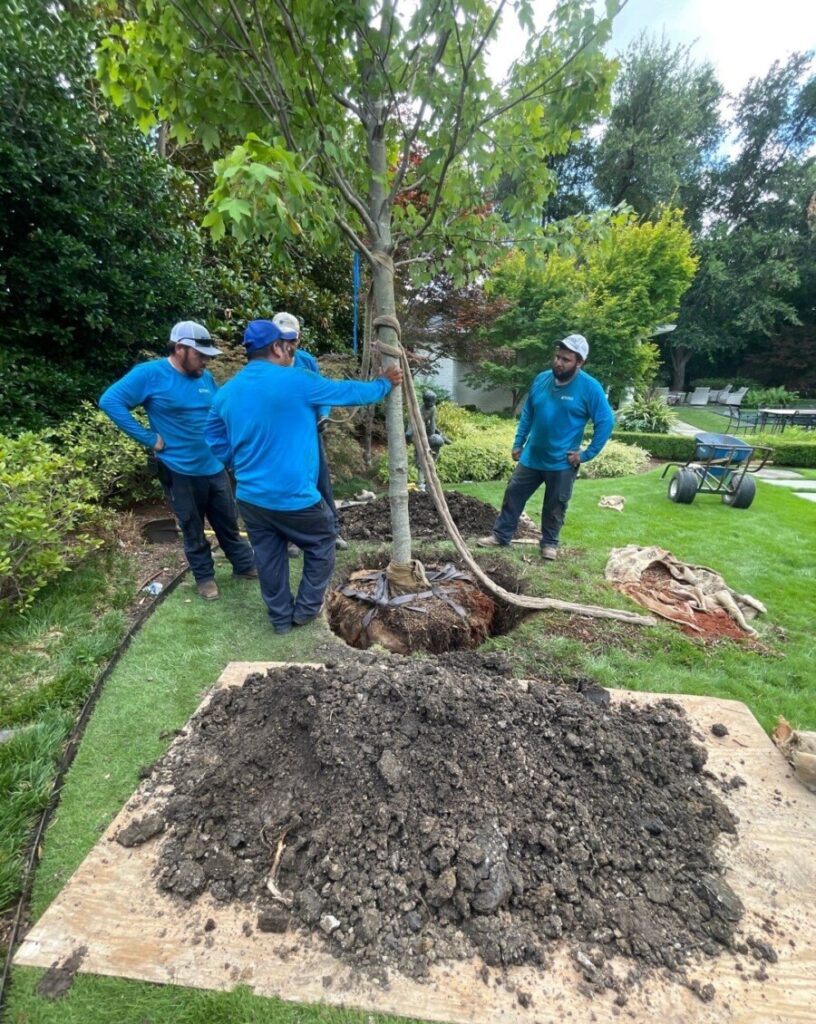
While Bonick Landscaping advocates tree preservation whenever possible, occasionally, a mature tree must come down. In this case, our team works in tandem with our trusted arborist partner to:
- Ensure removal follows city tree ordinances and permits
- Procure and plant appropriate replacement species
- Implement strategic planting methods so new trees flourish and grow
4. Support city and community programs
Dallas arborists often partner with:
- The City of Dallas Park and Recreation Department and Texas Trees Foundation on reforestation initiatives such as Branching Out, which emphasize proper planting, species selection, and ongoing care.
- Neighborhood groups and HOAs to educate residents on tree care, species selection, and how to get grants or support for canopy improvements.

Urban Forest Renewal
When Dallas arborists thoughtfully replace aging or unhealthy mature trees, they select species that are drought‑ and heat‑tolerant, structurally sound, pest‑resistant, and appropriate for the site’s size and use.
For fast-growing trees, we generally recommend lacebark elm and the Texas ash. However, cedar elm, live oak, pistache, and Mexican sycamore are other considerations.
Large Legacy Trees
For adding or replacing long-living expanded shade with high‑impact canopy similar to old oaks, pecans, or elms:
- Shumard red oak / Texas red oak
- Chinquapin oak
- Live oak
- Pecan
- Southern magnolia
- Cedar elm / Lacebark elm
- Bigtooth maple
- Mexican sycamore

Medium Tree Species
To replace mid‑size or declining trees, or adding understory structure beneath remaining legacy trees:
- Texas pistache
- Goldenrain tree
- Prairie sumac
- Texas mountain laurel
- Desert willow
- Redbud (Texas/Mexican redbud)
- Mexican buckeye
- Eve’s necklace
Resilient Native Trees
For challenging conditions (heat, radiant exposure, poor soils):
- Mesquite (Honey mesquite)
- Ashe juniper

How Dallas Arborists Select Replacement Trees
- Match species to site size and function
Plant large oaks, magnolia, pecan, elm, or sycamore in spaces that allow for a 40–60+ ft canopy; use redbud, mountain laurel, buckeye, and desert willow in areas of limited space or infrastructure. - Prioritize native and well‑adapted species
The best urban forest strategy integrates native or well‑adapted trees; these use less water, need fewer inputs, and are better equiped to survive heat waves and drought. - Diversify species
To minimize climate and disease risk, avoid replacing all mature trees with a single species; instead, mix oaks, elms, magnolia, maple, and native ornamentals. - Plant to ordinance and best practice
Employing certified arborists and skilled landscape professionals ensures that new trees follow the City of Dallas’ Article X soil volume and spacing requirements for maximum tree health.

Enlist the Professionals
If you have concerns about the health of your trees, contact your Bonick Garden Manager. We’ll evaluate the situation and, when needed, bring in the appropriate tree health specialist to develop the right treatment plan for your estate’s needs.
Resources:
You May Also Enjoy:
The Beauty of Bark: Unique Bark Colors & Textures in Texas